The Elegant Universe
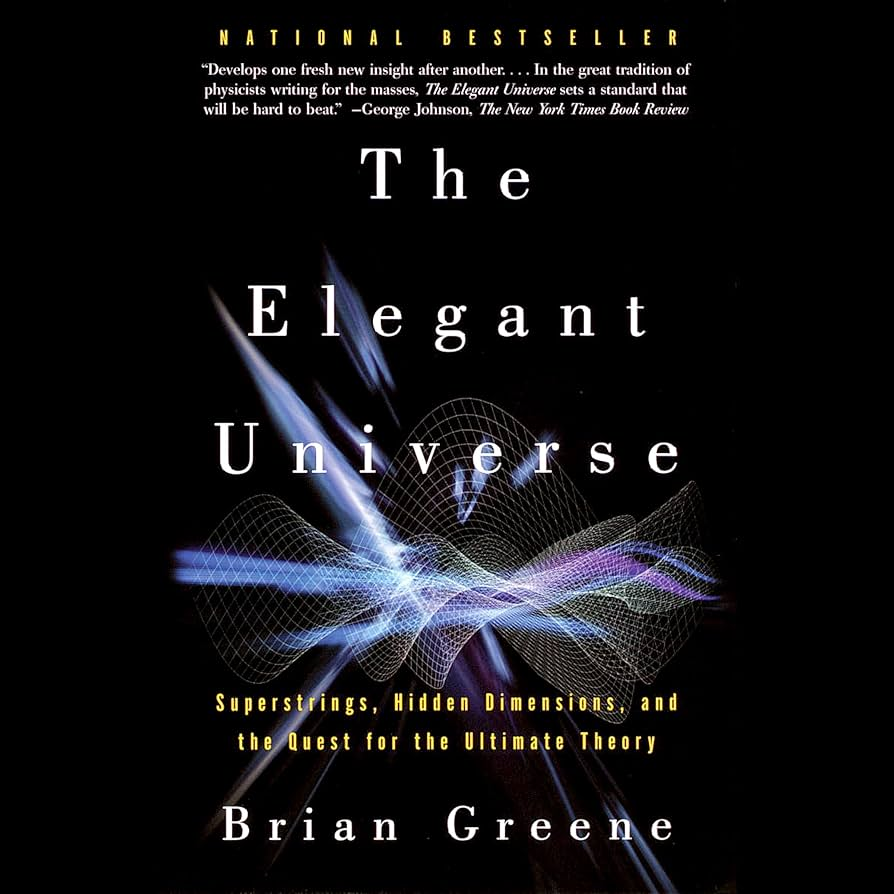
Running thoughts while reading. A formalized note from the post-Interstellar string-theory rabbit hole. Feb-Mar 2025
Why this book?
I started this because Interstellar pushed me toward quantum physics, branes, higher dimensions, and the whole strange architecture of string theory. Kip Thorne’s scientific imagination in The Science of Interstellar made me want at least a basic grip on why physicists talk about extra dimensions and why those ideas are tempting, even when they remain speculative.
So this book became the next step: not a textbook, but a structured attempt to understand the emotional and conceptual pull of string theory. I wanted to know what exactly makes the theory beautiful enough for people to keep chasing it.
Running Log
27-02-2025
- The early chapters were a pleasurable read because a lot of the material was already familiar from videos and popular explanations.
- Special relativity, general relativity, quantum mechanics, and the broad problem of unifying them were not new to me, but Greene gave them a cleaner narrative shape.
- At this point, the book felt like preparation before the heavy stuff began.
08-03-2025
- By this stage, the book had gone deep into superstring theory, symmetry, and the central incompatibility between general relativity and quantum mechanics.
- What I appreciated was that Greene does not pretend string theory is proven. He directly addresses skepticism and asks the reader to consider the mathematical beauty of the framework, while still acknowledging that beauty is not proof.
- The history of string theory was especially useful: a theory that began in one context, fell out of fashion, and later returned as a candidate for quantum gravity.
16-03-2025
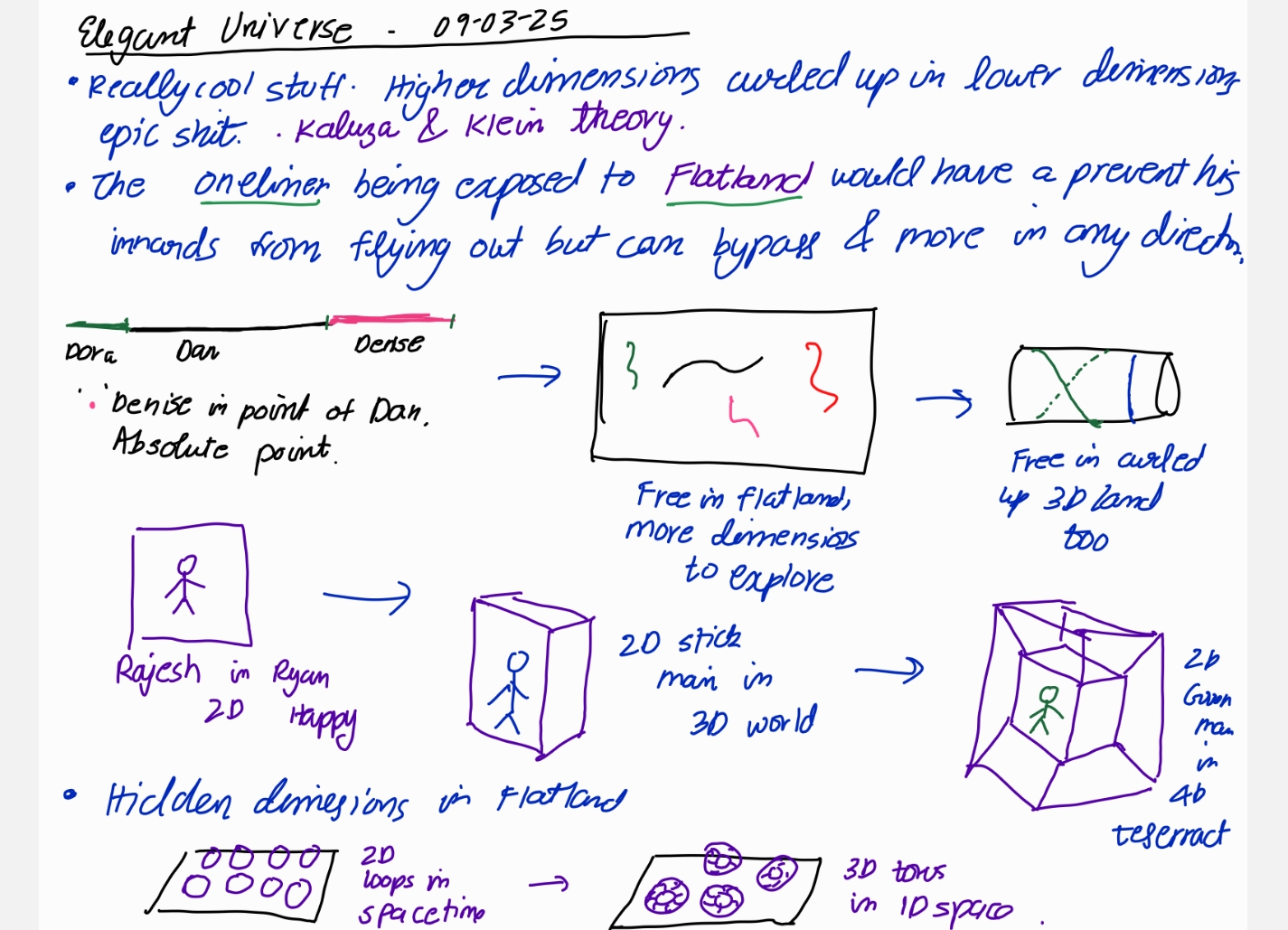
- The ideas around extra dimensions, compactification, and dimensional shrinking started making more sense.
- I think this worked because I had already encountered these ideas before. The book did not blow open an entirely new door, but it helped the earlier fragments settle into a more coherent picture.
18-03-2025
- Greene keeps putting out banger after banger of ideas.
- The entropy discussion, especially the book-stack example, was very clear. That kind of analogy is where the book is strongest: it turns a difficult abstraction into something holdable.
- The black hole sections were also fascinating. String theory and black holes feel like they are pointing at something real, even if the full theory is still incomplete.
19-03-2025
- Finished the book.
- It is an enigma in itself, but Greene deserves credit for making the material as accessible as possible.
- Whenever a concept might break someone’s head, he either tones it down with an analogy or asks the reader to hold onto the idea until it makes sense later.
- Cosmic inflation finally clicked a little better too.
- The branes and higher-dimensional framing connected back nicely to The Science of Interstellar. I can see why Kip Thorne used those ideas as part of the conceptual toolkit for the film, even if he was not presenting string theory itself as established fact.
Learned Lessons
- Strings are far too small to be directly probed by current particle accelerators. At those scales, the energy required would overwhelm the very thing we are trying to observe.
- String theory tries to soften the infinities that appear when general relativity and quantum mechanics collide, especially through the way extended strings replace point particles.
- M-theory and duality are central ideas. Different string theories may be different limits or descriptions of the same deeper structure.
- The water-and-ice analogy helped: apparently different physical descriptions may be phases of one underlying theory, with the string coupling constant acting like a control parameter.
- Extra dimensions are not merely science-fiction decoration. In string theory, they are part of the mathematical machinery needed to make the theory consistent.
What Worked
The best part of the book is Greene’s ability to make speculative physics feel intellectually honest. It is clearly a pro-string-theory book, but it does not erase the uncertainty. He repeatedly returns to the distinction between mathematical elegance and experimental confirmation.
That matters because string theory lives in a dangerous zone: too beautiful to ignore, too hard to test, and too ambitious to dismiss casually. Greene’s book captures that tension well.
The analogies also carry the book. Relativity, quantum mechanics, curled-up dimensions, entropy, black holes, duality: each gets translated into a mental image that is simple enough to remember without becoming insulting.
What Did Not Fully Land
I was disappointed that the landscape problem did not get serious attention. The question of why our universe has these particular constants and laws feels central to modern skepticism about string theory, and its absence makes the book feel slightly incomplete from a later vantage point.
Also, because I already knew many of the concepts from videos and earlier reading, the book was not as mind-blowing as it might have been if I had encountered it cold. It was more a book of good surprises than crazy surprises.
Handwritten Notes
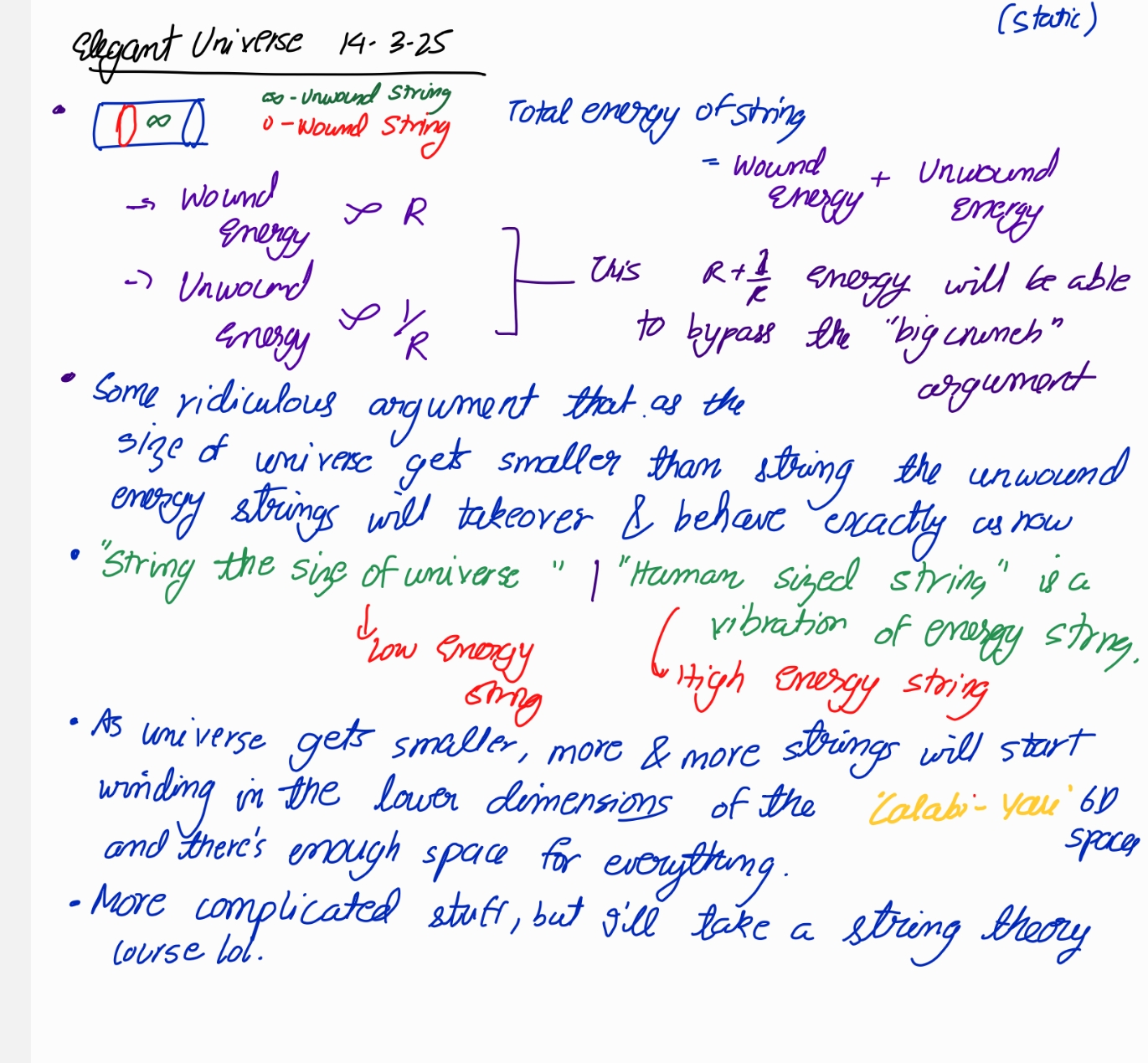
These pages are the raw parts of the book that I had to draw out to make sense of them: higher dimensions curled into lower dimensions, the Flatland analogy, compactification, wound strings, unwound strings, and the strange idea that a shrinking universe can be redescribed through string winding modes.
Final Thoughts
This is a strong popular-science book: accessible, ambitious, and surprisingly careful for something so enthusiastic about string theory. It did not convert me into a string-theory believer, but it did help me understand why the theory has such gravitational pull on physicists.
The book’s deepest value is not that it proves string theory. It shows why the dream of unification is so seductive: the hope that quantum mechanics, relativity, black holes, particles, cosmology, and extra dimensions might all be different faces of a single underlying structure.
Pretty fun, when you think of it that way.
Resources To Chase
- String theory
- Superstring theory
- Supersymmetry
- Calabi-Yau manifold
- Extra dimensions
- Quantum gravity
- M-theory
- Cosmic inflation
- Joseph Polchinski: String Theory, Vols. 1 and 2
- Barton Zwiebach: A First Course in String Theory