The Black Swan

Running thoughts while reading. Unfiltered, argumentative, and deeply engaged. Jan–Feb 2025
Why this book?
It’s been two years since I read Fooled by Randomness, and getting back to Taleb was always the goal. Never found the time though. Until now, and man, I was in for a ride. There’s a lot of concepts to unpack here, and the guy is well-read, philosophically inclined, and an absolute iconoclast. Nothing stops him from thinking in terms that would make most academics uncomfortable.
Running Log
15-01-2025
- Right off the bat, interesting thoughts. He opens with the Lebanon war, draws parallels to how someone experienced World War I, the same blindsided shock. This guy seems deeply into philosophical esoteric topics.
- His point that having a bit of money and intellectual freedom to pursue whatever you want gives you the time and headspace to actually think. Simple, but it hits different.
- The idea of Mediocristan and Extremistan: data that is scalable vs. non-scalable, linear vs. non-linear returns. The Wharton school notion of “scalable jobs.” This framing alone is worth the price of the book.
- His idea that recognising interesting events is hard, and requires genuinely good thinking? Makes hella sense.
22-01-2025
- Man, this is beautiful. I like the weird but interesting thoughts. Since the author is so outspoken, I’m stress-testing every single one of his arguments, looking for cracks. And this is because whatever he says goes directly against my existing worldview.
- But that’s exactly the point, the book is making me sharper by forcing me to defend positions I took for granted. Earlier I wasn’t supposed to be Fooled by Randomness; this time, I need to understand the nature of tail events.
- Had an interesting conversation where I stumbled onto the concept of skin-in-the-game, which is his next book. Felt like a confirmation bias high, but it was genuinely cool.
03-02-2025
- Took a hiatus. Gotta reread notes to get back into the flow. Packed week, but we push on.
06-02-2025
- Completed the main book, just the postscripts left. This guy has engaged my brain on multiple levels, mostly by being outrageously different from what I think one “should” be. He believes our institutions need to change, and change they should.
- I’ve had so many conversations with Claude and ChatGPT trying to unpack where this guy’s ideas come from. And it turns out, understanding exactly what he means matters more than agreeing or disagreeing.
- This is what I like about this book: it challenges opinions, offers new angles, and ultimately makes my mind more fertile. That’s a good sign. He goes after one of the fundamental tenets of my belief: science, and how science works. And I think that’s healthy.
07-02-2025
- What this has given me: more books to read. First up is The Structure of Scientific Revolutions, followed by Antifragile and Skin in the Game. Not because he left things out, but because these are the puzzle pieces he’s hinting at, and I want the full picture.
10-02-2025
- Finally done. The very end has some strategies and thinking frameworks that I suspect will stay with me. Forces me to re-examine the limits of knowledge and how our scientific enterprise is built. I don’t fully understand the math Taleb references (he “talks” about it more than he shows it), but I plan to dig into that later.
Glossary (From the Book)
⚠ Warning
I didn’t do original research here. These definitions are from the book’s own glossary. Keeping them as useful reference anchors.
Barbell Strategy: Protect most of your assets from all uncertainty, but allocate a small portion for extremely aggressive high-risk plays. Defense + offense simultaneously.
Empty-Suit Problem (“Expert Problem”): Some professionals (clinical psychologists, academic economists, risk “experts,” financial analysts, CEOs) have no real differential ability vs. the general population, yet are treated as authorities. They dress it up with jargon, math, and expensive suits.
Locke’s Madman: Someone who reasons perfectly from faulty premises. Impeccable logic, garbage foundations. Taleb’s favourite targets: Samuelson, Merton, Debreu.
Narrative Fallacy: Our compulsion to fit a story or pattern to a series of facts, connected or not. The statistical cousin is data mining.
Fooled by Randomness: Confusing luck with skill or determinism. Leads to beliefs like “high earnings in certain professions = pure skill” when luck plays a massive role.
Reverse-Engineering Problem: Predicting how an ice cube melts into a puddle is easy. Looking at a puddle and guessing the ice cube’s shape? Nearly impossible. This asymmetry makes narrative disciplines (including history) inherently suspect.
Mediocristan: The domain of the mediocre. No single observation can meaningfully shift the aggregate. The bell curve lives here.
Extremistan: The domain where a single observation can blow up the total. Winner-take-all territory.
Ludic Fallacy: Studying chance using the neat world of games and dice, then assuming reality works the same way. Real randomness has an extra layer of uncertainty about the rules themselves. The Gaussian bell curve is, per Taleb, the “Great Intellectual Fraud”: the ludic fallacy applied to randomness.
Mandelbrotian Gray Swan: Black Swans we can somewhat account for (earthquakes, blockbuster books, market crashes) but whose properties we can never pin down precisely.
Final Thoughts
Nature of the Author
He’s bold and unabashed. There’s this ease when he’s discussing normal stuff, which is completely overwhelmed when he starts going after economists and bankers. He absolutely abhors groupthink, especially the academic kind. His idea of standing by a position isn’t single-minded devotion, it’s more like empirical stubbornness.
He hates some Nobel Prize winners in economics and their utter uselessness in real-world scenarios. This proper dissident-intellectual thinking is… revolting to a conformist like me. It takes real courage to think outside the box.
And he hates the Black–Scholes model? The lesson: don’t trust anyone on authority. Even the ones who have more knowledge than you. Because sometimes, the same knowledge blinds them to alternate paths. A person who’s walked the same road a thousand times doesn’t see the dirt path leading somewhere new.
Nature of the Randomness
The Gaussian curve as a non-linear one-way hash function. It’s madness to look for patterns in the output of a function when the function itself is flawed. That’s a great way to frame the whole problem.
Taleb also says the 2008 Crisis wasn’t a Black Swan. It was a white one. They could see it coming, but didn’t stop it.
He first ridicules how people are fooled by randomness, then attacks the Gaussian directly. Even the Galton’s board chapter, showing how Galton himself was disillusioned.
Nature of Scientific Progress
Big, big fan of Falsifiability. Doesn’t let go of it. He holds Karl Popper to be a great philosopher. I still need to read more Popper, but interesting.
He has a way of proposing a gargantuan problem, and then offering a framework for thinking about it (→ Anti-Fragility & Skin in the Game). One of the coolest moments was when I was talking to ChatGPT about the book’s claims and stumbled onto the skin-in-the-game concept. Was blown away by how simple it seems. Like getting validated for a confirmation bias, but it was genuinely cool.
Post Points
Some stuff I forgot during the main review. Adding as I remember.
- The concept of scalable and unscalable jobs from management school. Taleb’s verdict: unscalable jobs are unpredictable garbage. Harsh, but he commits to the bit.
- The turkey problem which leads straight into the problem of induction in philosophy. Not forgetting that one.
On Understanding the Book (Scorecard)
ℹ Info
Taleb lists 13 common misunderstandings of his book. I went through each one and graded myself: 🟩 = I got it right, ❌ = I fell for it.
1. Mistaking the Black Swan for the logical problem. 🟩 Didn’t make this mistake. A Black Swan is a fact of nature, you can’t “spot it as a problem.”
2. Saying bad maps are better than no maps. ❌ This one got me. I was too angry at him for pointing it out. But his point is solid: you wouldn’t fly into LaGuardia using a map of Atlanta’s airport just because “there’s nothing else.” Yet economists do exactly this with Mediocristan tools in Extremistan.
3. Thinking a Black Swan should be a Black Swan to all observers. 🟩 Got the skin-in-the-game concept early. For the experts, Black Swans aren’t surprises, they can see the nonlinearity building, even if they don’t know exactly what will happen.
4. Not understanding the value of negative advice (“Don’t do”). 🟩 It’s like Bukowski’s “Don’t try” philosophy, but these corporate types always want to fix things rather than build more robust systems. My counterpoint: You should use Gaussian models as a starting point, acknowledge they’re wrong, and iterate toward better ones. If you don’t try, you never proceed forward. Don’t just sit idle with your hands in the air. Keep trying.
5. Not understanding that doing nothing can be better than doing something harmful. ❌ Same tension as above. I’m still critical. Just because you can’t predict something doesn’t mean you shouldn’t try to explain it. Even non-causal situations have causes worth probing.
6. Slapping labels like “skepticism” or “fat tails” onto the ideas. ❌ Don’t have the mental fortitude for this level of academic gatekeeping lol.
7. Thinking the book is just about bell curve errors, fixable by swapping in Mandelbrotian numbers. 🟩 The author grilled this in: don’t try to predict with wrong models. Stop digging for dirt in gold and go back to the lab.
8. Claiming “we knew all this” and then going bust in 2008. ❌ Can’t relate to this one personally.
9. Confusing Taleb’s ideas with Popper’s falsification. ❌ I did initially conflate them. But they’re fundamentally different; Taleb took inspiration from Popper, that’s all. Learnt this right at the end.
10. Treating probabilities of future states as measurable quantities. 🟩 The moment he introduced Mediocristan and Extremistan, this clicked completely. Really good framing.
11. Obsessing over ontic vs. epistemic randomness instead of Mediocristan vs. Extremistan. 🟩 Not a pedant, more of an empiricist. Don’t have this problem.
12. Thinking he says “Don’t forecast” instead of “Don’t use sterile forecasts with huge error.” 🟩 Got it while reading the postscript. Danke schön, author!
13. Mistaking “this is where s**t happens” for just “s**t happens.” 🟩 Got it, soldier. Understood the distinction!
Final score: 8/13 🟩, 5/13 ❌. Not bad for a conformist, I think.
Reading List (Spawned by This Book)
Taleb-adjacent thinkers I want to explore:
- Carlota Perez
- Robin Hanson
- Helen Longino
- Amartya Sen
- Byung-Chul Han
- James C. Scott
- Mariana Mazzucato
- David Graeber
More Links
- Taleb’s Congressional Testimony (PDF)
- Black Swans, or the limits of statistical modelling
- Risk Engineering Course
- Quantifying the unexpected: A scientific approach to Black Swans
- Doing Statistics Under Fat Tails: Taleb’s technical project on Black Swan mathematics
P.S.
I think I’ll buy a physical copy of this book. It has enough math and thinking density to be worth revisiting. I want to get into quant trading thinking, and this seems like a decent philosophical foundation for it.
P.P.S.
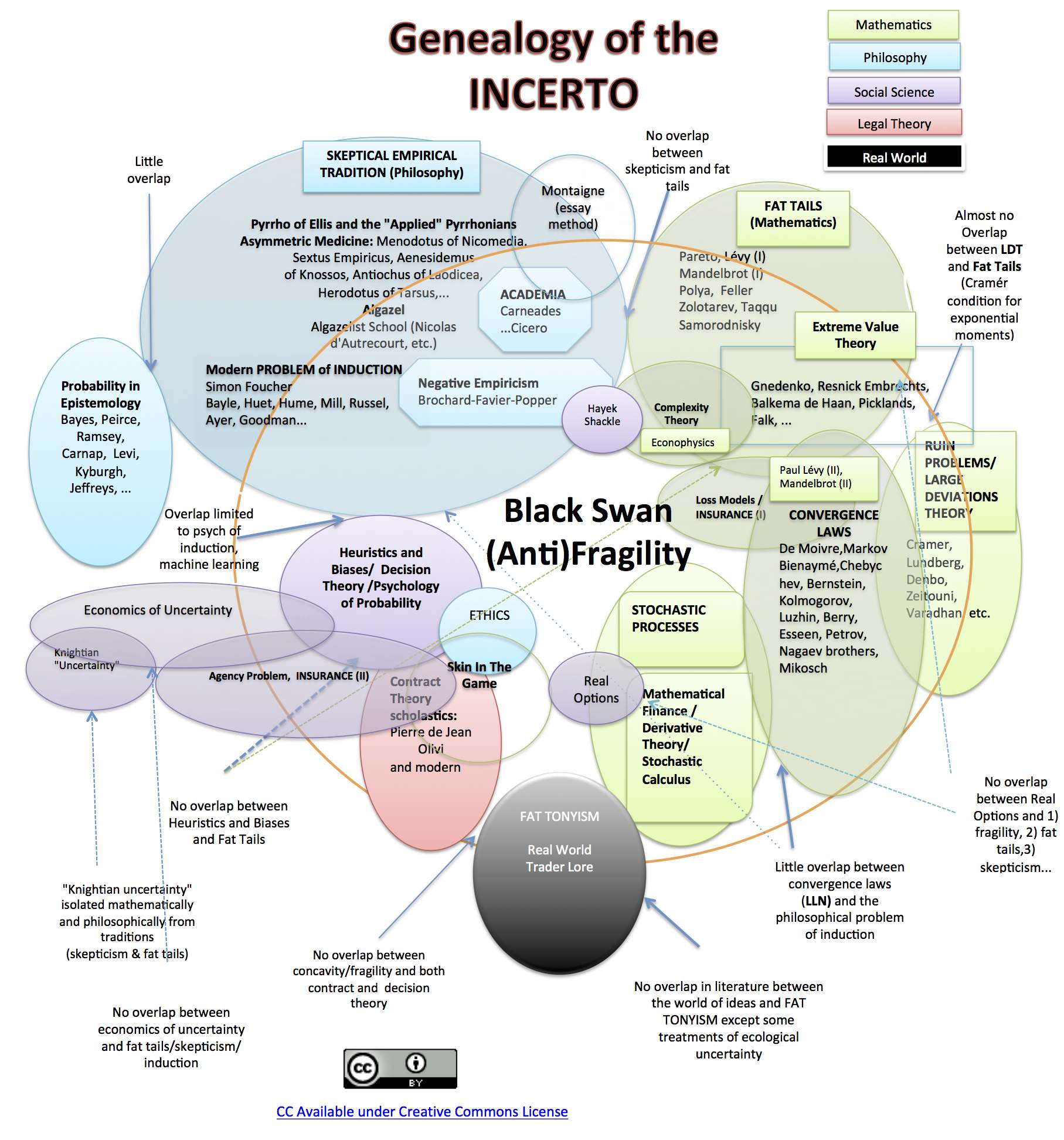
The Genealogy of the Incerto map that Taleb made is insane. The sheer breadth of fields he connects, from skeptical empiricism to stochastic processes to contract theory, is either the work of a genius polymath or a very confident madman. Probably both.
P.P.P.S.
My real takeaway: this book doesn’t just challenge what you think. It challenges how you think about thinking. And that’s the kind of book that earns shelf space.