AI Superpowers

Running thoughts while reading. Dated book, fresh takes. Jul 2025
Why this book?
This is a 2018 book, so yes, dated. But I figured it’d be a fun story regardless, and the China vs. Silicon Valley framing seemed like it would hold up even if the specifics didn’t. Spoiler: the first half delivered. The second half… less so.
Running Log
07-07-2025
- Picking this up knowing it’s old. Let’s see how it goes.
09-07-2025
- Damn, this has some juicy stories. Tonnes of interesting corporate drama between Chinese companies and I love it. Some early highlights:
- The Google Eye hotspot generation and the differences between American and Chinese approaches
- The Google fake medicine outrage
- The “Gladiator Entrepreneurs” chapter was epic brutal. The war between security companies and the sheer bloodletting required to reach a stable monopoly is crazy. And the sad part is: innovation never comes out clean, it just gets masked by extreme craziness. Maybe that’s why real innovation isn’t fostered?
- I see the same cycle playing out in India. WeChat Pay vs UPI, the bike revolution with Rapido/Uber transport, and more. History parallels development in interesting ways.
14-07-2025
- Really surprised by something: Chinese people are far more open to their data being handled by the government or external agencies, while Americans are way more particular about privacy. The author frames it as a cultural mindset shift, which is a simple but effective observation.
- Beyond the gladiators and data and government intervention, he’s getting into the philosophical territory of what happens to a world with AI but without human meaning. He’s hinting at something from AI 2027 or Bostrom’s Superintelligence, but in a more grounded way.
Core Concepts
The Four Waves of AI
(Similar framing to The Fourth Age)
Internet AI (Content AI & hyperoptimized recommendation engines): The traffic that drives the internet. Recommendation algorithms, content feeds, ad targeting.
Business AI: How people are guided toward buying things, optimizing drone delivery routes, medical analysis. Jobs that used to require humans are now hugely automated, and this wave is still accelerating.
Perception AI: The concept of OMO (Online Merge Offline). Think Meta glasses AI combined with all previous AI waves. This is you getting your pizza cooked exactly right because every link in the supply chain already knows your preferences and adjusts accordingly.
Autonomous AI: The pinnacle. Machines that don’t need us to run. Goals are so well-defined that the systems infer what to do without human guidance. This is where it gets existential.
The Job Reaping
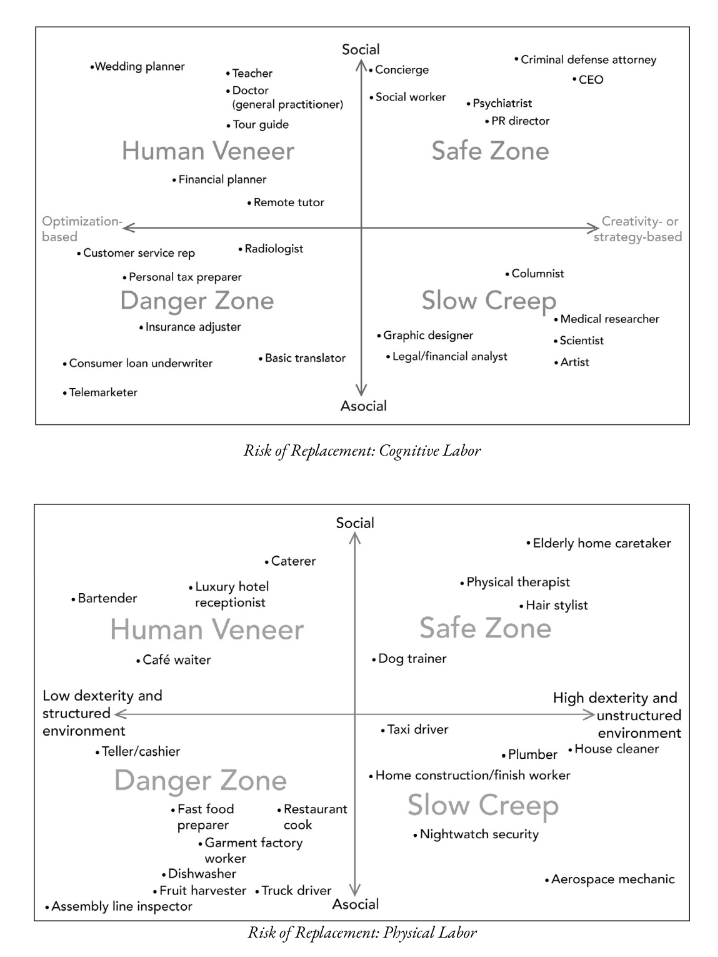
He maps out which jobs will survive and which won’t, using two quadrant charts: one for cognitive labor, one for physical labor. The axes are social vs. asocial, and optimization-based vs. creativity/strategy-based (or low vs. high dexterity for physical). Four zones emerge:
- Safe Zone: High social + creative/strategic (CEOs, psychiatrists, criminal defense attorneys, physical therapists, hair stylists)
- Human Veneer: High social + optimization-based (teachers, tour guides, bartenders, cafe waiters). Humans stay for the warmth, not the function.
- Slow Creep: Low social + creative (graphic designers, scientists, artists, plumbers, aerospace mechanics). AI encroaches slowly.
- Danger Zone: Low social + optimization-based (telemarketers, insurance adjusters, fast food preparers, assembly line inspectors). These are gone or going.
Social Investment Stipend (SIS)
His proposed solution: a government salary given to people who invest their time in activities that promote a kind, compassionate, and creative society. Three categories: care work, community service, and education. They should be well compensated to build societal trust.
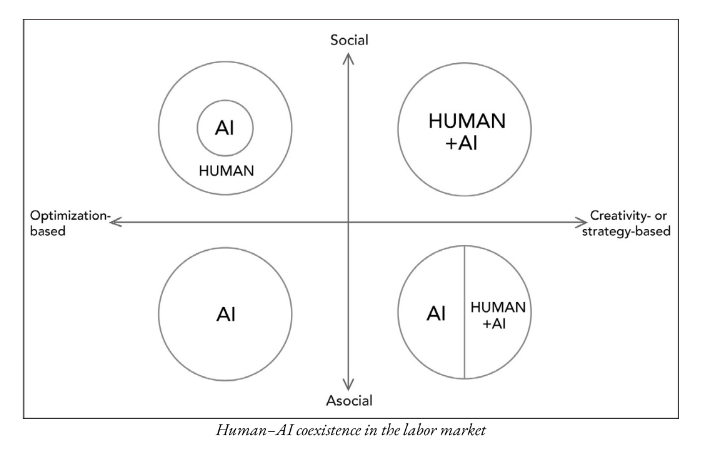
A very early, very basic AI alignment idea. The human-AI coexistence chart he draws is interesting as a framework.
Final Thoughts
This book had a great deal of insights… but only in the first half. I don’t know why, but the second half felt bloated. Too many words and sentences for the ideas being conveyed. I could flip through pages and still get the right idea, which is never a good sign.
The first half though? Golden. It hooked me. The Gladiator Entrepreneurs chapter alone was worth the read. And the observation that “Meta is the most Chinese company in Silicon Valley” stuck with me, especially given Meta’s talent poaching wars around the same time, paying $100M to grab top researchers. All in pursuit of superintelligence.
Compared to The Fourth Age (the other AI book I read), this one has more graphs and data but a weaker middle. The Fourth Age had a bigger bang in its core sections.
On the Ending
Not great, honestly. Kai-Fu Lee is trying to spread a message of love and oneness and how humans can help each other. And look, I get it. The spiritual masters have always known better than the human condition, and Lee is right to point them out as the pinnacle of what’s possible.
But I’ve got no hope that it’ll stick. Technological superiority will overpower any idealistic framework like this. As Our Oriental Heritage makes painfully clear, history is just a littered battleground between competing powers, and every era’s vision of peace and cooperation eventually gets steamrolled by the next wave of ambition. We get peace for a short period, then it dies out. There’s no escape from this cycle.
The SIS concept is a decent model and might work, but it requires a staggering amount of work. And framing an AI-free solution for an AI-driven problem feels… backwards? We’re incredibly complicated and it would take far more time, and far more failures (potentially ending in AI takeover), before we get our act together.
Ultimately, I’ll remember the first half. The gladiators, the cultural differences, the four waves. Let’s see how vividly that sticks.
P.S.
Reading a 2018 AI book in 2025 is a weird experience. Some predictions aged well (Perception AI is basically what Meta is building with their glasses). Others feel quaint. The speed of change since this was written makes even the “bold” predictions feel conservative.
P.P.S.
The China-India parallel I keep seeing deserves its own essay. WeChat Pay / UPI, bike-sharing / Rapido, government-backed tech ecosystems. The gladiator playbook is being rerun with different players.